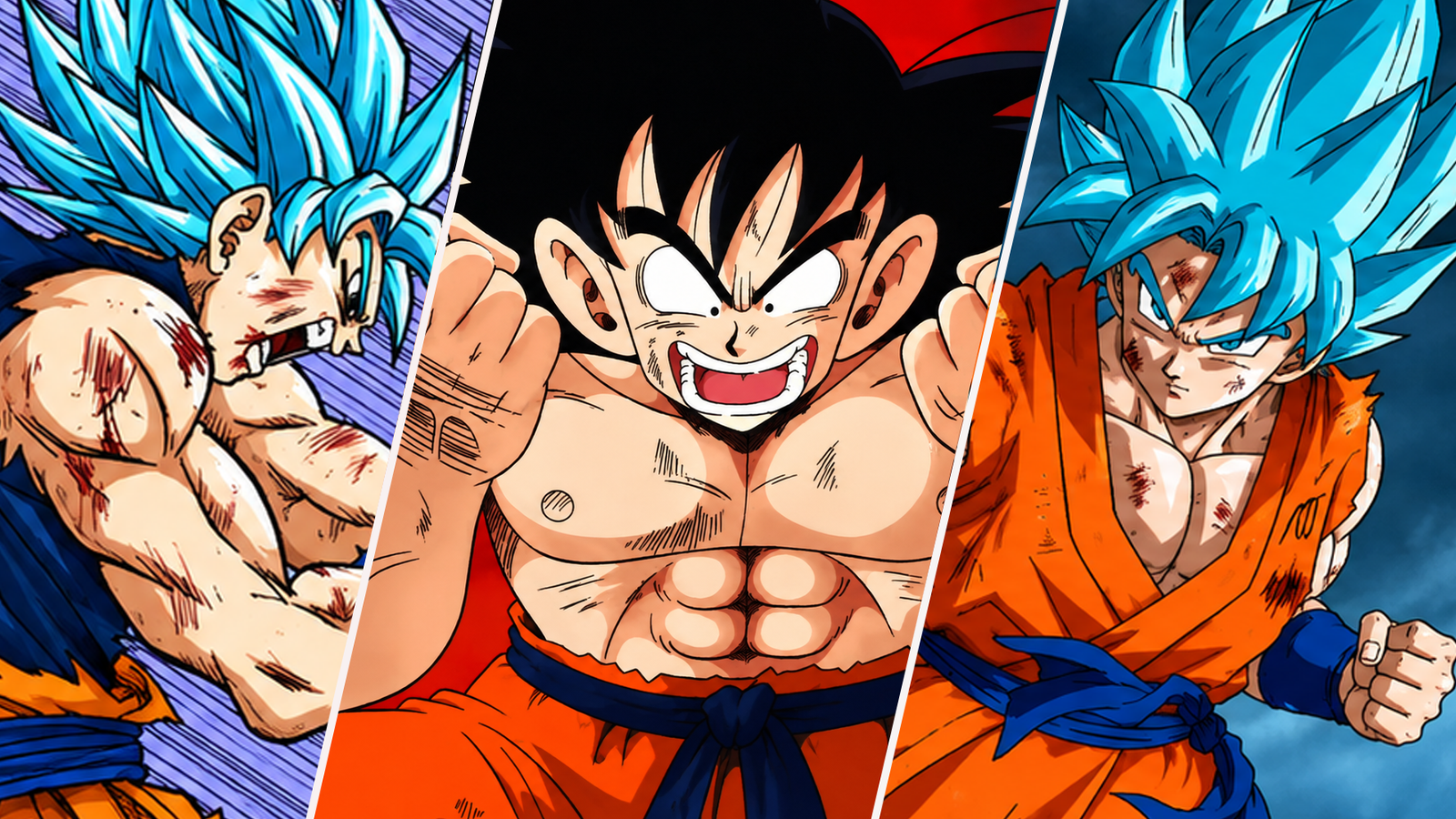
Goku may not be the strongest character in Dragon Ball right now, but he is without a doubt the greatest martial artist in the series. Goku has been called a battle genius multiple times throughout the series, and it’s not hard to see why. This is a man who can perfectly replicate new techniques just by seeing them once and manages to tap into an Angelic power mortals shouldn’t be able to access over the course of just 42 minutes.
Goku has an attack or ability for every situation, and while he has a few staple techniques he always goes to, Goku has a few rare – yet powerful – moves he only uses once. Most of the time, Goku just likes making his fights as fun as possible, so he won’t bust out his most overpowered techniques unless he absolutely has to.
5
Goku’s Meteor Combination Broke Piccolo Down

The 23rd Tenkaichi Budokai is one of Goku’s finest showings in the entire franchise. Goku just pulls out ability after ability as he fights circles around both Tien Shinhan and Piccolo. Near the end of his final battle with Piccolo, Goku pulls off a devastating physical combo called the Meteor Combination. Goku’s Meteor Combination is a multi-hit physical technique that strings several attacks together before finishing the opponent off with a Kamehameha.
The Meteor Combo nearly wins Goku the World Martial Arts Tournament. If nothing else, it wears Piccolo down enough that Goku is able to successfully knock him out by simply flying his body into him. Goku never uses the Meteor Combination again, but considering how Ki and flight-heavy fights in Dragon Ball Z and Dragon Ball Super are, there’s just no place for an ability that’s 90% physical and designed around ground combat.
4
The Feet Kamehameha Was Pure Genius

The Feet Kamehameha is another technique Goku pulled out during the 23rd Tenkaichi Budokai only to never use again. Interestingly, the Feet Kamehameha proves that the technique can be fired from anywhere, so long as the user is able to charge their Ki appropriately. During the World Tournament, Goku uses the Feet Kamehameha to launch himself into the air while hiding the fact he can fly.
Goku doesn’t use the Feet Kamehameha as an attack, so much as a means of traversal. That said, it still requires fully charging up the attack and he can’t hold back his Ki at this point in the series. If Goku wanted to be chaotic, he could pull out the Feet Kamehameha more often. Goku doesn’t really fight barefoot these days, though.
3
Goku Almost Ended the Goku Black Saga Early With the Mafuba

Also called the Evil Containment Wave, the Mafuba was introduced in the original Dragon Ball. During the Demon King Piccolo Saga, Master Roshi reveals that a martial artist can exchange their life force in order to perform the Mafuba: a technique which can seal away any being. So long as the Mafuba’s user has the correct seal, even the most powerful warriors in existence can be locked away by the Evil Containment Wave.
Goku ends up learning the Mafuba during the Goku Black Saga in Dragon Ball Super. In both the anime and manga, Goku’s plan is to get around Zamasu’s immortality by sealing him away ala Demon King Piccolo. Unfortunately for Goku, he forgets the seal in both continuities. In both versions of Dragon Ball Super, Goku just temporarily seals Zamasu away before he breaks out on account of no seal. If Zamasu weren’t immortal, Goku never would have used the Evil Containment Wave – a technique like this is basically cheating to him.
2
The Super God Shock Flash is the Best Thing to Come Out of Resurrection F
The Super God Shock Flash is also more commonly called the one-inch punch by Dragon Ball fans. Dragon Ball Z: Resurrection F has a lot of problems, but Super Saiyan Blue Goku slowly beating Golden Frieza to a pulp is fantastic to behold. The Super God Shock Flash is downright humiliating for Golden Frieza. Goku measures the distance between himself and Frieza, before striking him deep in the heart.
The attack is powerful enough to send Golden Frieza reeling, more or less giving Super Saiyan Blue Goku the edge for the rest of the match. It’s a shame Goku hasn’t used an attack this cool since, but the fact it only appears once is exactly what makes the Super God Shock Flash special. That said, it would be nice to get a callback in Goku and Frieza’s inevitable rematch in the Dragon Ball Super manga’s upcoming Black Frieza Saga.
1
Goku Loves Fighting Too Much to Perform Another Hakai

Goku is such a martial arts master, he was able to perfectly replicate a Hakai just by seeing Beerus perform it once. This is despite the fact that Goku doesn’t have access to Destructive energy and has no desire to become a Destroyer. The only time Goku uses a Hakai is when he’s fighting Fused Zamasu in the Dragon Ball Super manga. Goku begins slowly erasing Zamasu from existence, but the attack gets interrupted when Zamasu takes Mai hostage.
Goku technically does perform a Hakai one more time in the Galactic Patrol Prisoner Saga, but not as an attack – he merely uses the technique’s destructive properties to erase some rubble on top of Moro. When it comes down to it, Goku will never use a Hakai in battle again. The only reason he used one against Fused Zamasu was because he was immortal and the Z-Fighters had completely run out of options after Vegito defused.
- TV Show(s)
-
Dragon Ball, Dragon Ball Z, Dragon Ball GT, Dragon Ball Super, Dragon Ball DAIMA
- First TV Show
-
Dragon Ball
- Created by
-
Akira Toriyama
- Latest TV Show
-
Dragon Ball DAIMA
- Upcoming TV Shows
-
Dragon Ball DAIMA
- First Episode Air Date
-
February 26, 1986
PakarPBN
A Private Blog Network (PBN) is a collection of websites that are controlled by a single individual or organization and used primarily to build backlinks to a “money site” in order to influence its ranking in search engines such as Google. The core idea behind a PBN is based on the importance of backlinks in Google’s ranking algorithm. Since Google views backlinks as signals of authority and trust, some website owners attempt to artificially create these signals through a controlled network of sites.
In a typical PBN setup, the owner acquires expired or aged domains that already have existing authority, backlinks, and history. These domains are rebuilt with new content and hosted separately, often using different IP addresses, hosting providers, themes, and ownership details to make them appear unrelated. Within the content published on these sites, links are strategically placed that point to the main website the owner wants to rank higher. By doing this, the owner attempts to pass link equity (also known as “link juice”) from the PBN sites to the target website.
The purpose of a PBN is to give the impression that the target website is naturally earning links from multiple independent sources. If done effectively, this can temporarily improve keyword rankings, increase organic visibility, and drive more traffic from search results.